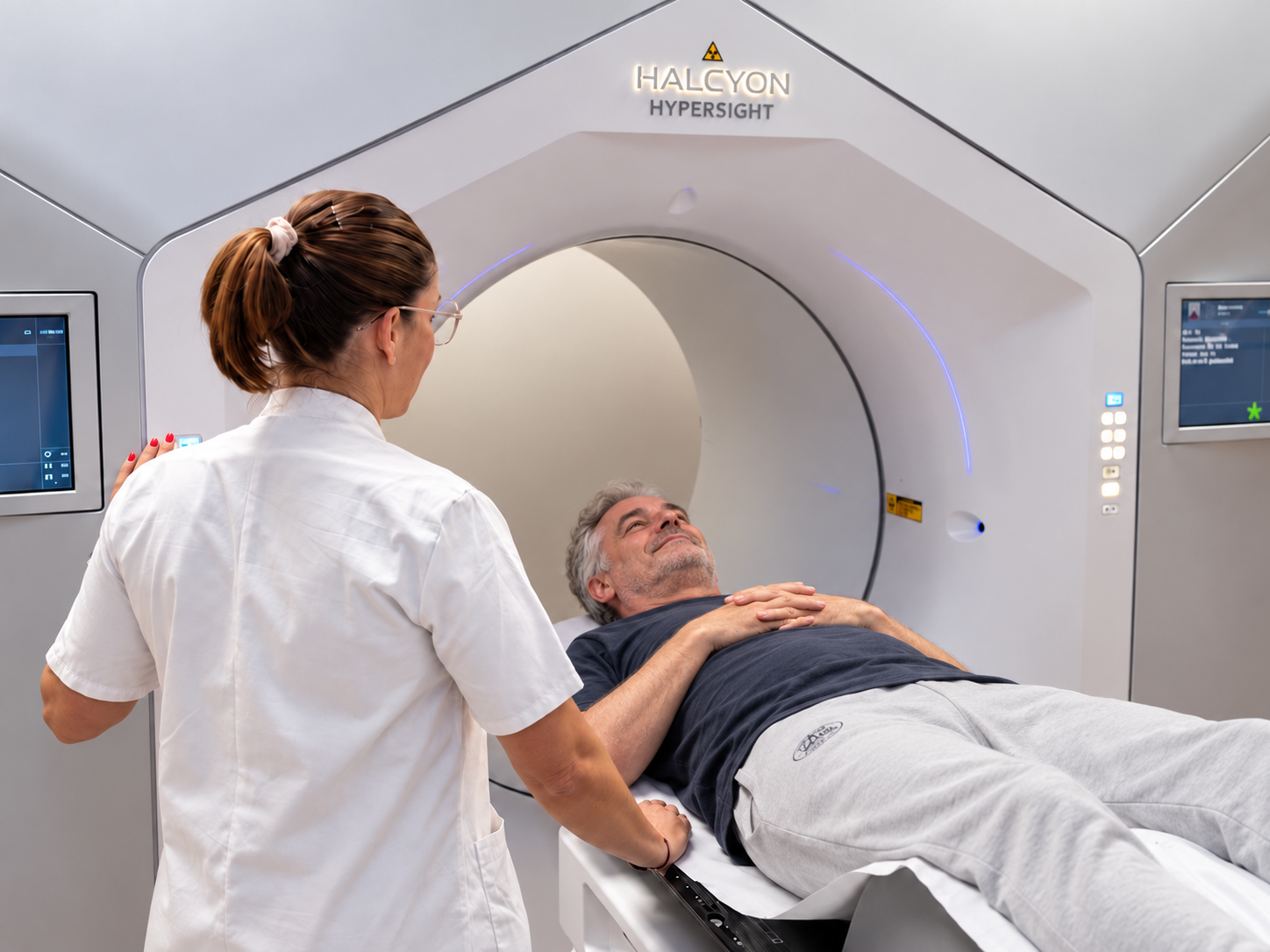
HyperSight: onboard CT imaging
HyperSight combines 3D imaging and treatment in the same room on Halcyon. For some indications, imaging can be used from the planning stage, directly in the treatment position.
Understanding HyperSight and the 24–48-hour pathway
CT directly on Halcyon
HyperSight greatly improves Halcyon's onboard imaging. It provides wide-field 3D images with quality and Hounsfield unit stability close to conventional CT. This precision allows dose calculation and treatment planning when the protocol permits.
The distinctive feature of the CBCTpworkflow on Halcyon is initial planning imaging directly in the treatment room: scout imaging, isocentre selection, localisation and positioning checks can be integrated into one sequence.
What this changes for patients
From imaging onwards, patients can be placed in the exact position used for radiotherapy, with necessary immobilisation. In some situations this reduces separate stages and helps the sequence from medical decision through imaging, contouring and dosimetry to treatment.
Faster acquisition also means less time staying still and fewer movements that could reduce image quality.
In Thiais: a rapid pathway for selected indications
When appropriate, the Centre uses this capability to organise a particularly short pathway:
- Consultation with the radiation oncologist and treatment decision.
- Planning imaging immediately afterwards, directly in the treatment position with suitable immobilisation.
- Priority contouring of the target and organs to protect.
- Accelerated dosimetry and medical physics checks.
- Aiming to start radiotherapy within 24 to 48 hours when the indication, records and technical checks allow.
This pathway does not replace any safety stage: it aims to remove waiting time between stages when they can be performed close together.
Bone metastases: reducing the wait when prompt pain relief is needed
This approach is particularly relevant for some painful bone metastases, where radiotherapy is often offered for pain relief or local lesion control. When suitable, shortening the consultation-to-treatment interval can avoid repeated journeys and improve access.
International rapid palliative radiotherapy programmes have shown that contouring, planning, quality checks and even treatment can take place on the same day in dedicated services. Thiais's 24–48-hour pathway follows this rapid-access approach while remaining individualised.
A recent technology already used internationally
HyperSight remains recent and not yet widespread. Halcyon installations are documented in several countries, including the United States, Netherlands, United Kingdom, Australia, India, Japan and South Korea. Early publications show growing interest in CBCT planning and more adaptive or faster radiotherapy pathways.
Speed does not mean rushing
The 24–48-hour interval is not suitable for every situation or an automatic promise. It depends on indication, available tests, patient condition, contouring and dosimetric complexity and approval of all necessary quality checks before irradiation.
The radiation oncologist and medical physics team always decide the pathway and technique.
Technical characteristics come from manufacturer documentation and clinical publications. The 24–48-hour pathway describes possible Centre organisation for selected indications.
- Siemens Healthineers / Varian — HyperSight and CBCTp workflow on Halcyon
- ESTRO / Maastro — First European installation and dosimetric evaluation
- Clatterbridge Cancer Centre — Halcyon with HyperSight
- FAST-METS — Rapid pathway for bone metastases
- Rapid palliative radiotherapy programme — Same-day planning and treatment